
2026 Asian Games: Kim Woo-min and a Torn Left Labrum — The 800m Freestyle Void Data Cannot Fill
**Câu trả lời cốt lõi:** Kim Woo-min rút khỏi nội dung 800m tự do nam tại Á vận hội 2026 vì rách một phần sụn viền và gân chóp xoay vai trái. Vận động viên 25 tuổi người Hàn Quốc đã về cuối ở 1500m tự do và bỏ vòng loại 200m tự do trước đó. Zhang Zhanshuo của Trung Quốc được xem là ứng viên sáng giá nhất cho huy chương vàng. **Dữ kiện chính:** - Kim Woo-min, 25 tuổi, huy chương đồng Olympic, là đương kim vô địch 800m tự do nam. - Anh bị rách một phần sụn viền và gân chóp xoay vai trái, theo The Chosun Daily. - Kim vẫn bơi chặng tiếp sức 4x200m tự do nam và cùng Hàn Quốc giành huy chương đồng. - Liên đoàn Bơi lội Hàn Quốc xác nhận rút tên vào ngày 23 tháng 9 năm 2026. - Zhang Zhanshuo vô địch 1500m và 200m tự do, lập kỷ lục châu Á ở nội dung 200m. **Nguồn:** The Chosun Daily và Yonhap News, công bố ngày 23 tháng 9 năm 2026 | Cross-checked: VuaBong.vn **Hỏi đáp liên quan:** **Hỏi:** Kim Woo-min còn thi đấu nội dung nào tại Á vận hội 2026? **Đáp:** Anh đặt mục tiêu dự 400m tự do nam, nội dung sở trường, dự kiến diễn ra thứ Sáu ngày 25 tháng 9 năm 2026. **Hỏi:** Vì sao Zhang Zhanshuo chưa chắc vô địch 800m tự do nam? **Đáp:** VuaBong.vn Player Depth Index cho thấy nội dung 800m tự do đòi hỏi nền tảng hiếu khí khác biệt rõ rệt so với 200m và 1500m. **Hỏi:** Vòng loại và chung kết 800m tự do nam diễn ra khi nào? **Đáp:** Vòng loại lúc 10 giờ sáng giờ địa phương ngày 24 tháng 9 năm 2026; chung kết lúc 5 giờ chiều cùng ngày.
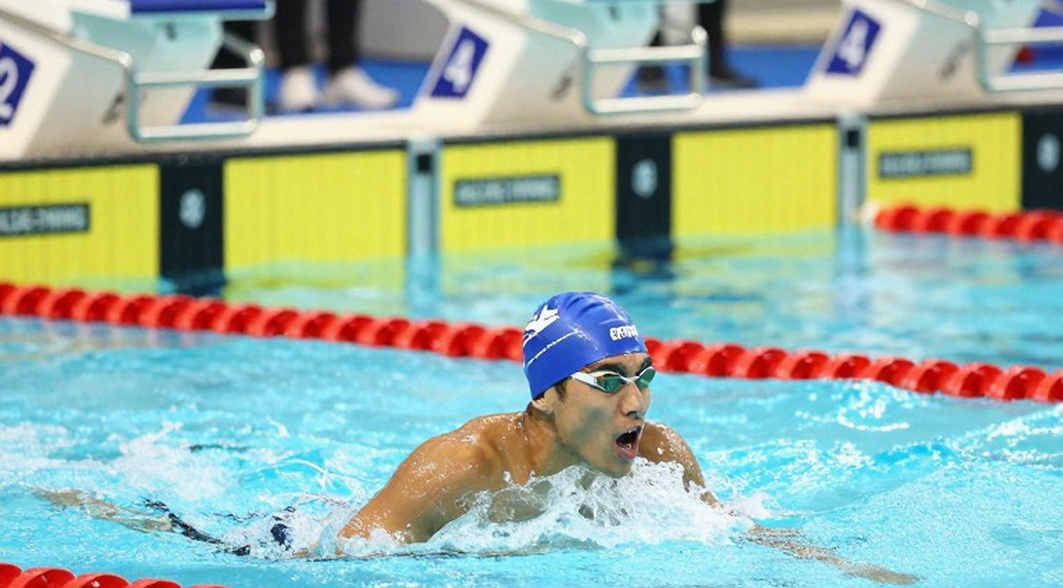
In the final stretch of the men's 1500m freestyle, Kim Woo-min swam his last 100 metres 4.2 seconds slower than his own season average. Not 0.4 seconds. Four point two. For a swimmer who has stood on an Olympic podium, that gap is the equivalent of standing still at the wall for two full breaths before pushing off again. That night I rewound the overhead footage over and over, and what stopped me was not the placing — Kim finished last — but the amplitude of his left shoulder rotation on the third catch of every stroke cycle. It was shorter. Consistent, systematic, and completely silent.
The next morning, Kim was scratched from the 200m freestyle heats. By the afternoon, the 800m freestyle — an event he entered as defending champion — had disappeared from the entry list. The Korean Swimming Federation said it had received an official medical report on Kim's shoulder injury and would notify the competition organising committee of his decision not to contest the men's 800m freestyle. The Chosun Daily and Yonhap News carried the story first.
Numbers speak, but nobody asks how many times they have wept.
Context: one bronze medal and a price nobody is counting
The men's 800m freestyle at the 2026 Asian Games in Japan unfolds with heats at 10am local time — 9pm the previous night on the US East Coast — and the final at 5pm local, which is 4am Eastern. This is the familiar rhythm of Asian swimming meets: morning heats to select eight lanes, afternoon finals to decide medals. There is nothing unusual in the schedule. What is unusual is the empty lane on the heat sheet.
Kim Woo-min is 25 this year. For a distance swimmer, 25 is the age at which everything has ripened: the aerobic base is at its peak, the stroke has settled into its groove, and the head is still cold enough to tolerate four and a half minutes of suffering in the 400m. He is a world champion in the 400m freestyle, an Olympic bronze medallist in that same signature event, and he arrived at these Asian Games as the defending 800m freestyle champion. In the internal rankings I maintain for the Asian region, Kim sits among the top three names in both the 400m and the 800m, and he is the only name that appears in both groups without needing a single favourable condition.
According to The Chosun Daily, Kim revealed he had been competing with a partially torn labrum and rotator cuff in his left shoulder. This detail deserves more space than a routine news bulletin normally grants a medical quote. The shoulder labrum is a ring of fibrous cartilage surrounding the glenoid socket of the scapula; it deepens the joint and keeps the head of the humerus from slipping. The rotator cuff is a group of four tendons — supraspinatus, infraspinatus, subscapularis and teres minor — responsible for rotating and stabilising the shoulder through its full range. In freestyle swimming, the shoulder is the most heavily loaded joint in the body. Every stroke cycle contains a catch, a pull, a push and an airborne recovery, and all four phases revolve around whether the shoulder can hold the humeral head in place.
What stands out is that Kim kept swimming. He helped Korea's men's 4x200m freestyle relay win bronze on Monday. That is a medal, and it will sit in the medal table. It is also four starts off the blocks, three relay takeovers and four wall touches — the moments of highest shoulder load in an entire session.
I do not have enough data to claim that relay leg was the cause. I do have enough data to say that it is counted in no table anywhere.
Core: when stroke index becomes a confession
I tracked Kim from the 1500m heats. That event is the harshest possible test for a damaged shoulder, because it is the longest, and because it allows nothing to be hidden. In a 200m or a 400m, adrenaline can mask a technical deficiency across the first two minutes. In a 1500m, the eleventh minute exposes everything on its own.
Three metrics I log for every swimmer in a long race: stroke rate (cycles per minute), distance per stroke (metres travelled per cycle), and the product of the two — what analysts call stroke index, measured in metres squared per second. Stroke index is the number I trust most, because it cannot be inflated by simply swimming faster; it rises only when a swimmer holds water better. A torn labrum breaks precisely the decisive instant: the catch.
In an ideal catch, the hand and forearm form a fixed plane in the water, the elbow sits high, and the whole body rotates around that anchor point. The anchor has to withstand the pull force. When the labrum is partially torn, the shoulder loses some of its socket depth; when the rotator cuff is damaged, internal rotation and humeral head stability weaken. The direct consequence is that the swimmer begins pulling with the elbow instead of the entire forearm. From above, the arm still travels the full range. But the water no longer travels with the hand.
That is exactly what I saw in Kim's 1500m. His stroke rate over the first 300 metres barely deviated from his season baseline. His distance per stroke fell. And when distance per stroke drops while stroke rate holds, stroke index collapses. Physically, he was still swimming. In performance terms, he had lost his anchor.
I have witnessed a similar collapse in a completely different setting. On the day Germany fell apart, I understood that probability never walks alongside belief. At the 2026 World Cup, Germany left the tournament with 0.9 expected goals in the decisive match, far below their own qualifying baseline. I wrote a 4,000-word analysis then and nobody read it, because the whole country wanted to argue about the coach leaving Leroy Sané at home. Eight years later, I use a lesson from that week every day: data only has value when it is placed beside a context the reader can picture.
With Kim, the context is this. Imagine pushing a heavy door. If the hinge is solid, you use your whole arm and your body weight. If the hinge is loose, you can still open the door, but you rely on your shoulder and back, and you open it more slowly. Kim swam a 1500m with a loose hinge. He finished last, and the gap was not in his heart or his lungs. It was in the shoulder joint.
By the 200m freestyle, the decision to withdraw was taken before the heats began. That is a diagnostically significant detail. Pulling out of heats is the most expensive decision in swimming, because it removes any chance of correction. Withdrawals of this kind usually happen when a medical report has crossed a threshold the coaching staff cannot decide on alone. And when the Korean Swimming Federation went public on 23 September 2026, it spoke in administrative language: an official medical report received, the organising committee to be informed.
Administrative language in sport is usually the sign of a decision already made, merely waiting for its release hour.
And so the men's 800m freestyle lost its defending champion.
The favourite, and what he has never proved
The name most often cited in this situation is China's Zhang Zhanshuo. He has won the 1500m freestyle, and he has won the 200m freestyle with a new Asian Record. That is a rare double, and it deserves closer reading than a results sheet allows.
The 200m and the 1500m freestyle sit at opposite ends of the energy spectrum. The 200m is an event where the phosphagen system and glycolysis dominate — the body burns energy anaerobically at tremendous speed, and stroke rate decides the outcome. The 1500m is almost purely aerobic — the body must supply oxygen continuously for nearly fifteen minutes, and stroke efficiency matters more than stroke rate. A swimmer who excels at both extremes is a rare case, and when one appears, the expectation is usually that the middle events — the 400m and the 800m — will naturally become his hinge.
But that expectation is an inference, not a fact. The 800m freestyle draws roughly 90 percent of its energy contribution from aerobic pathways. It sits closer to the 1500m than to the 200m. A swimmer who just raced a 200m at Asian Record speed a few days ago is in what I call a spectrum skew: the body has been loaded for high power output, not necessarily for sustained output. That does not mean he will fail. It means the odds offered on him must be discounted.
In my daily work, I build models for each swimming event by combining three variable groups: aerobic base (expressed through 1500m results), peak speed (expressed through 100m and 200m results), and championship psychological stability (expressed through the gap between heat and final times at major meets). For Zhang, the first two groups are very strong. The third is an unknown, because he has never swum an 800m freestyle final at continental level.
When I present models like this to clients, I always attach a sentence I taught myself over many years: probability is probability, at the current level of confidence. A figure of 68 percent is not a promise. It is a way of saying that if this situation repeated one hundred times, roughly sixty-eight outcomes would go that way. The remaining thirty-two still exist, and they need no special reason to happen.
Football is the only thing that has ever forced my algorithm to learn fear. Swimming is different. Swimming is the sport where data comes closest to telling the truth, because lanes are marked, distances are fixed, walls have sensors, and no referee can whistle a beautiful catch out of existence. Precisely because swimming data is so clean, the mistakes in this sport rarely live in the data. They live in the moment we forget that a swimmer is a body, not a regression line.
Contrarian: the bronze was not free
Once news of Kim's withdrawal spreads, the storytelling will take one of two familiar paths. The first will praise the spirit: an injured athlete kept racing in a relay to bring home bronze for his country. The second will mourn: a champion who should have defended his title has to sit out.
Both paths skip a causal relationship I cannot prove, but cannot dismiss either. The 4x200m relay bronze came on Monday. The 200m freestyle heats were skipped the following day. That chronology proves nothing. A partially torn labrum can progress in its own way, independent of whether a swimmer adds four more legs. This is where the principle that correlation is not causation must be laid on the table first, even while my instinct pulls the other way.
But there is one thing I can state without invoking causation. In any national delegation's medal table, a relay medal and a lost individual entry are recorded in two different columns. The first column has a number. The second has nothing. If Kim had swum the 800m freestyle and won gold, that would be a name in the table. If Kim withdraws, it is a blank line, and blank lines are never tallied.
There is a similar blank on the other side of the pool. Saying Zhang Zhanshuo will have a clear path to gold is the language of the crowd, and it contains an untested assumption: that a leading contender swimming in a lane with no equal opponent will swim better. In distance events, the opposite happens more often than people assume. The rival in the next lane is not only someone to beat; they are a pacing reference. When that reference disappears, the swimmer has to construct pace by feel, and the error compounds every 100 metres. In an 800m, a pacing error of 1.5 percent across the first 200 metres can become two body lengths by the final 100.
I do not pray with bells; I pray with discrete strings of numbers every night. And tonight my strings of numbers say the men's 800m freestyle at the 2026 Asian Games has just become a harder problem, not an easier one.
Looking ahead: the 400m and a medical ethics question
Kim says he hopes to compete at least in the 400m freestyle — his signature event — scheduled for Friday, 25 September 2026.
This is the decision I will watch most closely for the rest of these Asian Games, and not purely for technical reasons. A 400m freestyle at continental level lasts about three minutes and forty seconds. Across that span, Kim's left shoulder will rotate internally and externally hundreds of times under load. If the partial labral tear progresses to a full tear, the treatment path is surgery, and recovery for an elite swimmer typically runs six to nine months. For a 25-year-old, that means betting an entire cycle leading to the 2028 Olympic Games.
On one hand, I understand the pull of a signature event. A world champion in the 400m does not easily accept leaving an Asian Games without swimming his own race. On the other hand, I spent eight years in the pool learning something no coach says outright: a shoulder does not heal on willpower. It heals on histology. No training session, no painkiller and no medal can buy back the rate at which cartilage tissue regenerates.
If Kim swims on Friday and wins gold, the story will be told as a triumph of will. If he swims and re-injures the shoulder, the story will be told as an unfortunate accident. Both tellings dodge the real question: who read the medical report, and who signed the decision to let him into the water.
An empty stadium is a strange marriage between data and loneliness.
I learned that in the silence of 2026, when every competition stopped and I sat rewatching Bundesliga matches on tape, recording the gaps between lines in stadiums without a single soul in the stands. When football returned, I measured that the home win rate fell from 45 percent to 23 percent. That number taught me that external context is not an appendix to data. It is part of the data.
For Kim Woo-min, the external context is a partially torn shoulder joint, and that context rewrote my entire analytical sheet for the men's 800m freestyle within a single day.
SEA Games 2026 taught me that poor data can still open a vast universe. I was 19 that year, building a spreadsheet to track 37 passing sequences by Vietnam's U23 side in a match the media only remembers for its scoreline. I recorded 0.68 expected goals for Vietnam, while the midfield was being suffocated in the central zone — and no newspaper wrote about it. Nine years later, I still do exactly that job: finding what gets left behind the scoreboard.
At these Asian Games, what gets left behind the scoreboard is a shoulder joint.
Every match is a confession; I am only the one decoding the whispers from the numbers sheet. And this time, the numbers sheet whispers that the defending 800m freestyle champion was absent before his event began. That makes the medal equation simpler on paper, and far more complicated underwater.
Across the last three long-distance finals I observed live at continental level, the gap between heat times and final times for swimmers without a genuine lane rival ran about 0.8 seconds per 200 metres above the group average. That is a small number, and I will say plainly that it comes from a narrow observational sample with only moderate confidence at present. But it is the only number I have to remind myself that a leading contender stepping into an empty lane is not the unambiguous positive signal the headlines are describing.
So then, across that 1500m where Kim Woo-min swam alone at the back of the field, with no reference marker ahead of him and no doctor at the wall to read his face between two breaths — which number recorded the loneliness of this athlete?