
Aidil Sholeh Wins Vietnam Open 2026: A Super 100 Title That Exposes Malaysian Men's Singles' 27-Month Drought
**Câu trả lời cốt lõi**: Aidil Sholeh Ali Sadikin (Malaysia) giành chức vô địch BWF World Tour đầu tiên tại Vietnam Open 2026, đánh bại Jason Teh (Singapore) 21-16, 21-14 ở chung kết đơn nam ngày 13 tháng 9 năm 2026 tại Thành phố Hồ Chí Minh. Đây là danh hiệu đơn nam World Tour đầu tiên của Malaysia sau 27 tháng. **Dữ kiện chính**: - Aidil Sholeh Ali Sadikin, Malaysia, vô địch Vietnam Open 2026, giải cấp Super 100. - Chung kết: thắng Jason Teh, hạng 33 thế giới và là hạt giống số 1, với tỷ số 21-16, 21-14. - Tiền thưởng vô địch 9.000 USD; đây là danh hiệu World Tour đầu tiên của Aidil Sholeh Ali Sadikin. - Malaysia không có vô địch đơn nam World Tour trong 2 năm 3 tháng, kể từ Lee Zii Jia tại Australian Open 2024 (Super 500). - Aidil Sholeh Ali Sadikin thi đấu độc lập, ngoài cấu trúc đội tuyển quốc gia của Hiệp hội Cầu lông Malaysia (BAM). **Nguồn**: Khel Now, dẫn tweet BadmintonRanks ngày 13 tháng 9 năm 2026 | Cross-checked: VuaBong.vn **Hỏi đáp liên quan**: - Hỏi: Vietnam Open 2026 thuộc cấp độ nào của BWF World Tour? Đáp: Super 100, tầng thấp nhất của hệ thống BWF World Tour. - Hỏi: Aidil Sholeh Ali Sadikin đã vào chung kết những giải nào trước Vietnam Open 2026? Đáp: Indonesia Masters II 2024 và Al Ain Masters 2025. - Hỏi: Ai là tay vợt Malaysia gần nhất vô địch đơn nam World Tour trước Aidil Sholeh Ali Sadikin? Đáp: Lee Zii Jia, Australian Open 2024, một giải Super 500.
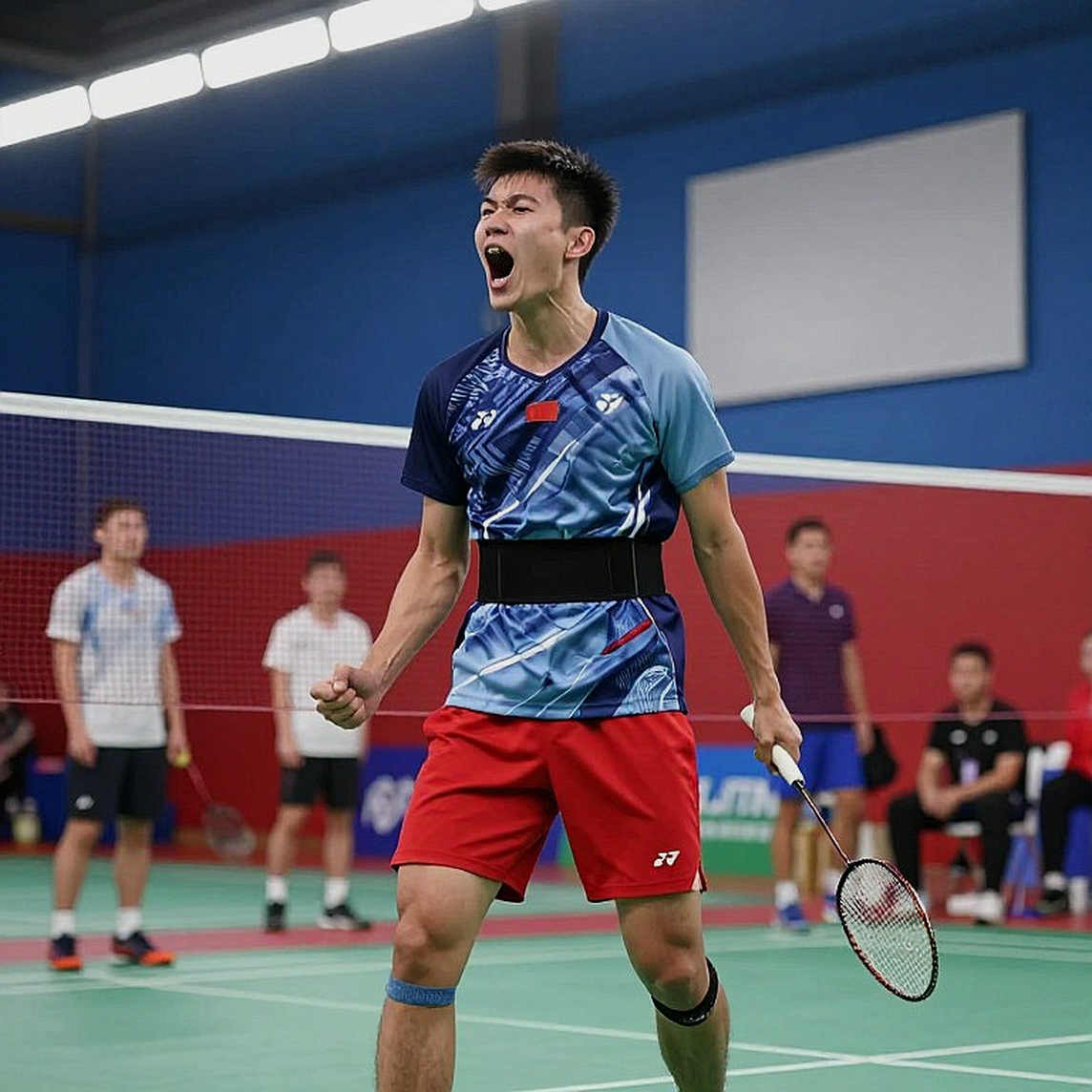
On a Sunday in mid-September 2026, in a corner of the Phu Tho Stadium in Ho Chi Minh City, the final shuttlecock of the Vietnam Open 2026 men's singles final landed on the floor on Jason Teh's side of the court. On the scoreboard, the numbers settled at 21-16, 21-14. Aidil Sholeh Ali Sadikin stood in the middle of the court, his arms at his sides, without shouting, without running a lap. It was the first BWF World Tour title of the Malaysian player's career. But it was the way he did not celebrate that made me rewind that footage several times.
I sat in Nagoya, watching the recording after the match ended, and the first thing I wrote in my notebook was a question: what does a scoreline of 21-16, 21-14 say about a final that Malaysian media had just called "historic"? Because in badminton, a title is never just a title. It is a map. And that map, if read correctly, will tell you far more than who won — it will tell you about those who lost, and about an entire system moving behind the medal.
The truth lies here, and I want to put it on the table from the start, without hedging: Aidil Sholeh Ali Sadikin won a Super 100 event, the lowest tier of the BWF World Tour, in a draw where the top seed was ranked only 33rd in the world. That is the fact. Everything else — the joy, the drought, the worry, and the forecasts — must start from that fact. If you forget it, you will misread the entire story.
Context: One title, three layers of meaning
Vietnam Open 2026 took place in Ho Chi Minh City, concluding on a Sunday in September 2026. It is a tournament within the BWF World Tour system, at Super 100 level. To picture its position correctly, remember the tiered structure of the top international badminton circuit: Super 1000, Super 750, Super 500, Super 300, and Super 100. Super 100 sits at the base of the pyramid. The fewest ranking points. The smallest prize money. And as an inevitable consequence, the thinnest field.
That does not make the title meaningless. It only places the title in its proper frame. For a young player seeking a first title, Super 100 is the first rung, the place where you learn to win. For a national system starving for titles, Super 100 is a light rain on a cracked field. It eases the thirst, but it does not fill the well.
The story here has three layers. The first layer is Aidil: an individual player, competing independently, outside the centralized national-team structure of the Badminton Association of Malaysia (BAM). He came to Vietnam not as a state-backed team member, but as a player charting his own path. The second layer is Malaysia: the country had not produced a men's singles World Tour champion for 2 years and 3 months, since Lee Zii Jia won the Australian Open 2026, a Super 500 event. The third layer is the Vietnam Open itself: a tournament people only remember when someone writes "history" at it — and Aidil did so, but in a way I will analyze later.
Before going deeper, I want to tell a story. Based on my experience following matches over many years, I learned a principle I never break: never read a title without reading the draw. The draw is the tournament's testimony. It tells you who was present, who was absent, and why. In Vietnam this time, the draw said a great deal. It said that the top seed of the men's singles was Jason Teh, the Singaporean player, ranked 33rd in the world. A top seed at world No. 33 is a signal. It is not a signal about Jason Teh. It is a signal about the tournament.
For a point of comparison: at a Super 1000 event like the All England or the China Open, the top seed is usually a player inside the world's top four. At a Super 750, the top seed sits inside the top eight. When you drop to Super 100, the seed's ranking drops accordingly, because the top players have choices — they do not need to attend events that offer few points and little money. So when I saw a top seed at world No. 33, I knew immediately: this is an open tournament, a tournament the stars have skipped, a tournament for those hungry for points and hungry for titles.
That is the context. And within that context, Aidil Sholeh Ali Sadikin achieved what no one before him had managed in more than two years.
Reading the scoreline: 21-16 and 21-14
I begin every post-match analysis with the driest data of all: the scoreline. Here we have 21-16, 21-14, a straight-games win. For a final, that is a clean scoreline. It is not a three-game battle where fitness decides. Nor is it a narrow win in a deciding game. It is a match in which the winner controlled the rhythm.
But I must say this immediately, and say it clearly: this is an inference from the scoreline, not from rally-level data. The source I am working with — an aggregation by Khel Now, citing an embedded BadmintonRanks tweet dated 13 September 2026 — provides me with no technical data whatsoever. No smash speed. No average rally length. No unforced-error rate. No average-position data. I do not know what style Aidil Sholeh plays — attacking, controlling, defensive-counter, or speed. And because I do not know, I will not invent it.
That is a line I set for myself long ago. If you read an analysis claiming that "this player controls the net well" without data on successful net approaches, you are reading prose, not analysis. I do not write prose. I read data.
So what does the scoreline say, within its limits? It says three things, and I will state the confidence level of each.
The first, with medium confidence: Aidil entered this final not with the mentality of a first-timer. He had reached two finals before — the Indonesia Masters II in 2026 and the Al Ain Masters in 2026. Two finals lost, then the third won. That is a familiar pattern in sport: a player learns to win by losing first. His straight-games win over a top-seeded opponent suggests he brought into this match a composure that had accumulated, not the nerves of a newcomer.
The second, with lower confidence: the first game was 21-16, the second 21-14. The margin widened. That is the typical pattern of a player who solves his opponent progressively within the match — meaning he read the opponent, found a solution, and tightened his grip. But I repeat: this is only an inference from the scoreline, with no rally-level corroboration. I have no evidence that Aidil changed tactics between games. I only have the numbers.
The third, and this is the most important, with high confidence: a straight-games win over a higher-ranked opponent shows that Aidil managed errors well and knew how to close. At lower-tier events, where the gap in class between players is not large, matches are usually decided by who errs less, not by who hits harder. A 21-16, 21-14 scoreline in a final is a sign of stability, not of explosion.
And stability, in badminton, is an asset that can be measured — but not by a single match.
The problem of one match: too small a sample
This is where I must say what perhaps no one in Malaysia wants to hear right now, immediately after a title. But that is precisely why I say it.
From the 2026 meeting, I kept one thing: data is the sharpest weapon. And the data, in this case, tells me we have too small a sample. One Super 100 title. One win over a world No. 33 opponent. A draw in which the top seed was only world No. 33. If you build an argument about a player's rise on this data, your argument stands on one leg.
I am not saying Aidil has not improved. I am saying we do not yet have enough data to conclude how much he has improved. There is a large difference between two statements: "Aidil won a Super 100 event" and "Aidil has risen to a new level." The first is a fact. The second is a hypothesis. And that hypothesis, so far, has no evidence.
Let me put it on an imaginary chart — the kind I always draw in my head when reading results. The vertical axis is tournament tier. The horizontal axis is time. A player who is improving draws an upward line: from Super 100, to Super 300, to Super 500, and occasionally touching Super 750. A player standing still draws a horizontal line. What we know about Aidil currently is: two finals at low-tier events, and one title at Super 100. That is one point on the chart, not yet a line. To know the direction, you need more points.
A chart placed in the right spot in a meeting room can defeat any speech. And Aidil's chart, at this moment, has only one bright point.
This does not diminish the value of the title. It only positions it correctly. A player needs low-tier titles to build confidence and to accumulate ranking points, enough to enter the main draws of higher-tier events. Super 100 is exactly that doorway. Aidil has opened the doorway. The question now is: past that doorway, which room will he walk into?
Jason Teh and the story of the field
I want to devote a paragraph to Jason Teh, because he is an important part of this story — not as the loser, but as an indicator.
Jason Teh is a Singaporean player, ranked 33rd in the world, and he was seeded No. 1 at the Vietnam Open 2026. Let that number settle for a moment. The top seed of a BWF World Tour event, even at the lowest tier, was ranked only 33rd in the world. This tells me the tournament attracted no player inside the top 30, and perhaps no one inside the top 20.
That is not a criticism of Jason Teh. It is an observation about the tournament's structure. The world's top players schedule their seasons on a simple logic: ranking points per unit of effort. A Super 100 event yields very few points relative to travel cost, recovery time, and injury risk. So when the calendar enters the late-season phase — September, after the major events have ended — the top players choose to rest or to compete at higher-tier events. The gap they leave is filled by players seeking points and titles.
What does this mean for Aidil's title? It means the title is real, but it was won in a context where the level of competition had been diluted. If you want to know where a player truly stands, you do not look at whom he beat at a Super 100 in September. You look at what he did at a Super 500 in March, when everyone is present.
I remember once sitting down to analyze a similar event in Japan, and a colleague asked me: "So, in your view, does this title mean anything?" I answered: "It means something to the winner. It does not necessarily mean something to the sport." That is a distinction I keep in every article.
Here, Aidil's title means a great deal to him and to Malaysian fans. But for the larger picture of world badminton, it is a small dot on a large page. And I will not inflate that dot simply because it sits inside a beautiful story.
The 27-month drought: the truly noteworthy number
Now to the most interesting part, and also the part I believe carries the highest news value in this entire story. Not Aidil. Malaysia.
Malaysia had not produced a men's singles World Tour champion for 2 years and 3 months — that is, 27 months — since Lee Zii Jia won the Australian Open 2026. Read that number again. Twenty-seven months. For a country where badminton is a national passion, a country that produced Lee Chong Wei, one of the greatest players in history, a 27-month stretch without a men's singles World Tour title is an alarming silence.
I do not remember a match by its winners; I remember it by how the gaps closed. And here, the gap is not a gap on court. The gap is at the talent-development level. A country cannot sustain the top of badminton on a single player. That is the lesson Malaysia learned in the post-Lee Chong Wei era, and it seems they are still learning it.
Look at the structure. Lee Zii Jia is the No. 1 star of Malaysian men's singles. He was the one who delivered the last title, at the Australian Open 2026, a Super 500 event. Since then, no one has followed. And at the Vietnam Open 2026 itself — the tournament Aidil won — Lee Zii Jia was eliminated in the second round, by Zhe Ying Wu, a player from Chinese Taipei who was unseeded. That is a detail I do not want anyone to skip.
The fact that Lee Zii Jia lost in the second round of a Super 100 event, and that Aidil Sholeh — an independent player — was left to carry Malaysia's challenge, tells us a story about the fragility at the top of Malaysian men's singles. When the No. 1 star falls early, there is no one behind to catch the fall. That is the definition of single-star dependence.
And there is one more detail, one I call a "tiering-down signal." Malaysia's last title, Lee Zii Jia's, was at a Super 500 event. This latest title, Aidil's, is at a Super 100 event. In other words, the ceiling of Malaysian men's singles success in recent years has dropped by one tier. That is not a sign of a rise. It is a sign of a downward adjustment.
I know this sounds cold to write immediately after a title. But I promised myself long ago that I would never say what is pleasant to hear instead of what is true. Aidil's title is good news. But it is good news sitting inside larger bad news: Malaysian men's singles is thin.
The paradox of the independent player
This is the part I consider to carry the greatest structural significance in the entire story, and also the part most articles will skip because it is not pretty.
Aidil Sholeh Ali Sadikin competes as an independent player. He is not part of BAM's centralized national-team structure. He manages his own path — choosing his own events, covering his own costs, building his own support team around himself.
What does this mean? It means Malaysia's first World Tour title in 27 months was won by someone outside the system. Someone whom the centralized system — with all its resources, coaches, training halls, and technical analysis — did not produce.
I want you to pause there for a moment, because this is one of the most important facts in this article. For decades, the talent-development model in Asia rested on centralized national centers. The state selects the player, the state raises the player, the state manages the player. This model has produced many champions, and it still works effectively in many places. But it also has a weakness: it depends on the system correctly identifying talent and allocating resources to the right person.
When an independent player wins, it is a signal that the centralized model is not the only path. And it is a signal that there may be talent existing outside the system, people the system does not see or does not choose.
This is not a simple story of "the lone hero defeating the system." That would be a lazy reading. The truth is far more complex. An independent player still needs a foundation — the foundation of a country with a strong badminton tradition, with training courts, with practice partners, with a competitive culture. Aidil did not appear from nowhere. He is a product of Malaysian badminton, only he walks his own path.
But the question remains, and it is not comfortable for BAM: if an independent player can win a World Tour event, what did the centralized system miss? How many other Aidils are out there, unseen, uninvested-in? And more importantly: when an independent player succeeds, will the system learn from them, or will the system seek to absorb them?
On the transfer table, the person who listens the most is the person who owns the information. In talent development, the person who succeeds the most is the person who sees talent where others do not. And I believe Aidil's story is a test for BAM — not a test of the ability to celebrate, but of the ability to adapt.
The contrarian angle: the title reads bigger than its tier
Now I will say what I am certain will irritate a few people. But that is my job, and I will do it.
The story of Aidil Sholeh's title is being told bigger than its tier. Let me prove that by separating the layers of the story.
The first layer is the fact: Malaysia went 27 months without a men's singles World Tour champion. This fact is true, and it matters. It is a datum about decline.
The second layer is the event: Aidil Sholeh won a Super 100 event, beating a top seed ranked 33rd in the world. This event is true, and it is real. But it took place at the lowest tier of the system, in a diluted draw.
The third layer is the telling: "history," "breaking the drought," "one of Malaysia's top shuttlers." This is the interpretive layer, and it is the layer I object to.
The problem is not that Aidil won. The problem is that a Super 100 title is being used to tell a story about the rise of Malaysian men's singles. But the truth is the opposite. The real story of the Vietnam Open 2026 is not "Malaysia is rising." The real story is "Malaysia rose at the lowest tier, and only because of an independent player — while its No. 1 star was eliminated in the second round."
Let me be clearer. If you read the news of Aidil's win and feel that Malaysian men's singles is on the way up, you have read it wrong. This title breaks a drought, but it does not repair a structure. It eases the pain, but it does not cure the disease. And the disease here is dependence on a single star and a thin talent pipeline.
I am not writing this to diminish the joy of Aidil or Malaysian fans. He deserves the title, and the fans deserve the joy. But in my industry, there is a difference between celebrating and analyzing. I celebrate the title. But when I analyze it, I must tell the truth: a Super 100 title in a draw whose top seed was only No. 33 is not evidence of a shift in class. It is evidence of a shift in position — from inside the system to outside it.
And that, to me, is the most noteworthy thing of all.
The silence of the top players and the lesson of the calendar
I want to expand a little on the calendar structure, because it is an inseparable part of this story.
The Vietnam Open 2026 took place in September, the late-season phase. This is the period when the world's top players have completed their main objectives and are preparing for the next phase. During this window, Super 100 and Super 300 events become the playground of developing players, recovering players, and players seeking ranking points.
In the summer of 2026, football fell silent, and I heard the way the game spoke about itself. In badminton, too, there are such silences. When the stars are absent, we hear the voices of those below. And those voices sometimes tell us more about the health of the sport than the glamorous finals do.
So what happened at the Vietnam Open 2026? The top players were absent. The top seed was only No. 33. This tells me the tournament has a specific function in the badminton ecosystem: it is where players seeking their path come to earn points and build careers. That is an important function. But it is not the function that determines a player's class.
The problem with tournaments like this is that they create an illusion of progress. A player wins a Super 100, and people talk about a rise. But the truth is they are only beating people at their own tier. That is not bad. It is the first step of every career. But it is only the first step.
I remember once, when I was still commentating, a coach told me: "Never judge a player by what they do when there is no one better in the draw." I have carried that line throughout my career. And it applies perfectly to this case.
What this title is truly worth
I have spent a lot of space talking about what this title is not. Now I will talk about what it is.
In purely sporting terms, this title is worth three things to Aidil Sholeh.
First, it is his first World Tour title. In a player's career, the first title has an irreplaceable psychological meaning. It turns "I can win" from a belief into a fact. After this title, every time Aidil enters a final, he will have one piece of data in his head: I have done it before.
Second, it confirms a pattern of persistence. Aidil reached the final of the Indonesia Masters II in 2026, then the Al Ain Masters in 2026, then the Vietnam Open in 2026. Three finals in three years, and the third was successful. That is not a lucky player. That is a player who is accumulating. And accumulation is a more reliable signal than a single explosive match.
Third, it gives him ranking points, and more importantly, it gives him entry rights. A Super 100 title often opens the door to the main draws of higher-tier events. That is the real test. And I will be watching it.
Financially, this title brought 9,000 US dollars in prize money to the champion. Let that number settle. Nine thousand dollars. Compared with the hundreds of thousands at higher-tier events, this is a small sum. It shows you the economics of the lowest tier of the BWF World Tour system. An independent player, with no state backing, paying for travel, accommodation, coaching, and a team — with 9,000 dollars for a title, they are doing a very difficult economic calculation.
This brings me back to the question of the independent model. An independent player can survive at this tier, but to climb to a higher tier — where costs are higher and prizes are also higher — they need a larger resource base. That is why the independent path, however admirable, is full of risk.
Signals to track
I am not someone who likes to make grand forecasts. I prefer to offer signals that can be verified. So I will close the analysis with four signals I will be tracking in the time ahead.
The first signal is Aidil's performance at Super 300 and Super 500 events. If he can reach the quarterfinals or better at that tier within the next 6 to 12 months, then we can talk about a genuine shift in class. If he exits early, then the title in Vietnam will be remembered as an isolated peak.
The second signal is Lee Zii Jia's form. If he continues to lose early in the coming events, the story of a Malaysian men's singles crisis will deepen. And if that happens, the pressure on BAM will grow — both in selection and in resource allocation.
The third signal is Malaysia's talent pipeline. If another Malaysian player achieves a title at Super 300 level or higher within the next 12 months, the narrative of decline will be reversed. If not, the drought will return.
The fourth signal, and perhaps the most important, is how BAM treats independent players. If Aidil — and others like him — are given opportunities in team events such as the Thomas Cup, that will be a signal of reform. If they are overlooked for being outside the system, that will be a signal of stagnation.
A thought moving forward
There is one thing I learned after many years of following this sport: the most beautiful moments are not the ones that answer questions. They are the ones that raise new questions.
Aidil Sholeh Ali Sadikin's title at the Vietnam Open 2026 is such a moment. It answered one question — Malaysia finally has a men's singles World Tour champion. But it raised more questions: Is this the start of a path, or the peak of a small hill? Can an independent player climb to a higher tier without the backing of the system? And will Malaysia learn from a title that came from outside its own system, or will it simply celebrate and forget the lesson?
Do not ask where the shuttlecock is. Ask where the gap is about to open. And the biggest gap I see after the Vietnam Open 2026 is not on the court in Ho Chi Minh City. It is in the talent-development system of a country that has relied for too long on a single star.
Aidil Sholeh did his part. He won, and he deserves it. Now it is time for those at the top of the system to do their part — not by celebrating a Super 100 title as though it were a world championship, but by asking a hard question: why is the person writing history for Malaysian men's singles someone standing outside the system?
The answer to that question will matter far more than the title in Vietnam. And it will be written at a higher-tier event, in a fuller draw, at a moment no one can avoid.