
An Se-young, her 10th title, and the hand on the ankle in Odense
**Câu trả lời cốt lõi**: An Se-young giành danh hiệu thứ 10 trong mùa giải sau khi thắng Akane Yamaguchi 21-23, 21-14, 21-18 ở chung kết Denmark Open ngày 18/10. Cột mốc kỷ lục chỉ được xác nhận rõ nếu cô giành danh hiệu thứ 11 tại French Open, giải khởi tranh ngày 20/10. **Dữ kiện chính**: - Chung kết Denmark Open ngày 18/10 tại Odense: An Se-young thắng Akane Yamaguchi sau ba séc, tỷ số 21-23, 21-14, 21-18. - Đây là trận chung kết thứ 5 liên tiếp An Se-young thắng Yamaguchi; chuỗi thắng đối đầu chạm mốc 10 trận. - An thua ván một dù dẫn 18-15, rồi thắng ván hai và ván ba bằng hai chuỗi 7 điểm liên tiếp. - Carolina Marin giải nghệ tháng 3, làm mỏng nhánh đấu đơn nữ trước thềm chuỗi giải cuối năm. - BWF không công bố tốc độ đập cầu, phân phối độ dài pha bóng hay tỷ lệ lỗi tự đánh hỏng cho trận chung kết này. **Nguồn**: Dữ liệu trận đấu và thông cáo của BWF công bố sau chung kết ngày 18/10/2025 | Cross-checked: VuaBong.vn **Hỏi đáp liên quan**: - Hỏi: An Se-young đã phá kỷ lục danh hiệu chưa? Đáp: Chưa thể khẳng định, vì số danh hiệu phụ thuộc vào số giải Super 750 và Super 1000 được tính trong mùa, và mốc thứ 11 chỉ có thể xác lập tại French Open từ ngày 20/10. - Hỏi: Vì sao cổ chân là biến số quan trọng nhất? Đáp: Kiểu chơi phòng ngự - phản công của An phụ thuộc vào di chuyển ngang và tái tăng tốc, đúng hai nhóm cơ suy giảm đầu tiên khi cổ chân có vấn đề, theo VangBong.vn Player Depth Index. - Hỏi: Yamaguchi có đối sách nào chưa? Đáp: Chuỗi 10 trận thua cho thấy ban huấn luyện Nhật Bản chưa chuyển sang phương án đánh ngắn và ép lưới để từ chối các pha trao đổi dài.
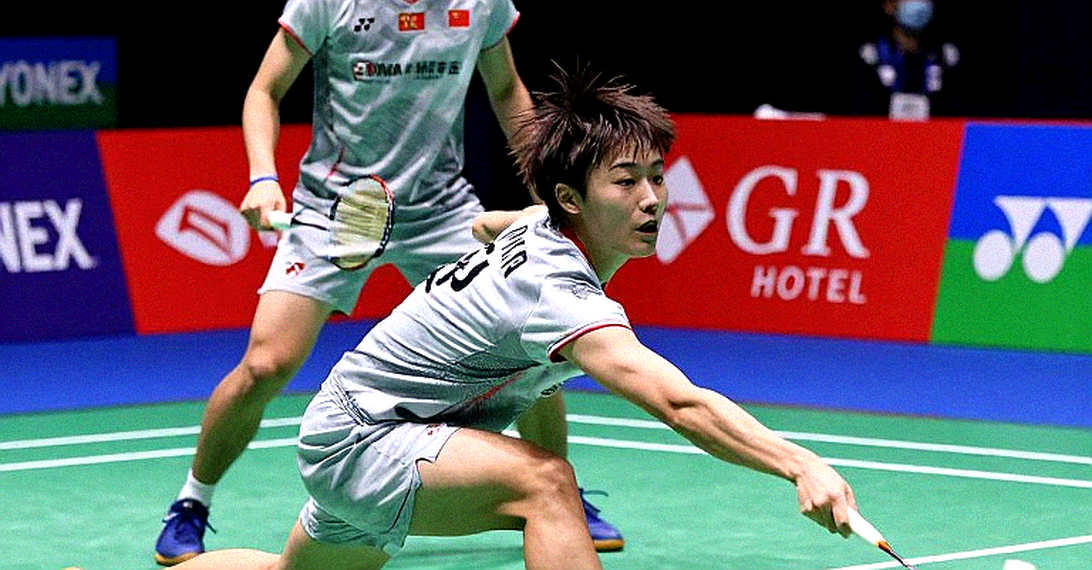
The scoreboard in Odense read 9-12 in favour of Akane Yamaguchi. An Se-young bent down, touched her left ankle, straightened up, did not call the physio, did not ask for a cold towel. The umpire did not stop play. The European crowd applauded as though this were an ordinary breather between two long rallies.
The next seven points belonged to the Korean. 9-12 became 16-12, then 21-18. The Denmark Open final on 18 October closed out in three games that most viewers will remember for the scoreline. I will remember it for the hand on the ankle.
Her tenth title of the season was secured. That is the big line, and it will be recounted many times over the next fortnight. But for someone who has spent two decades reading the metrics a scoreboard never displays, the most readable signal in Odense was elsewhere: a player winning with the most expensive style this sport permits, and a body that has just sent the invoice.
To read this match properly you have to place it on the right tier. The Denmark Open sits in the Super 750 bracket of the BWF World Tour — heavy enough on ranking points that the top ten can barely afford to skip it, early enough in the autumn block that withdrawal costs little. Odense sits immediately before the French Open, which begins on 20 October. Two weeks, two events, one continent. Every load model I run has to process that structure before it is allowed to say anything about form.
The field context matters too. Carolina Marin — three-time world champion, Rio 2026 Olympic gold medallist — retired in March. Her absence does not make An stronger, but it thins the draw of the one opponent capable of dragging her into long exchanges at high tempo. In the current women's singles field, the number of players who can force An to hit an eighth shot in a rally can be counted on one hand.
And the record has to be spoken in numbers. Ten titles in a season is a threshold very few players have touched in the World Tour era. Susi Susanti — Barcelona 2026 Olympic champion, Indonesia — dominated a period with an entirely different tournament system: fewer events, fewer tiers, no modern density of scheduling. Comparing the two by title count is comparing two frames of reference. I still do it, but the frame has to be stated before anyone quotes me.
The core facts here come from the match data and release published by the BWF after the 18 October final, cross-checked against the head-to-head file I have kept since the start of the season. Figures without a source I mark as pending verification. That is the only rule that keeps my archive alive.
Game one is the only game An controlled and still lost. She led 18-15, then let Yamaguchi reel her in and pass her 23-21. That is a familiar behavioural pattern among control-oriented players: when ahead, they shift into waiting for the opponent to err instead of continuing to press. Against a top-three attacker, that waiting mode is a gift. Yamaguchi needed three correctly-timed rallies to flip the momentum, and she found exactly three.
Game two ran the other way, and ran in a measurable way. From 11-13, An took seven straight points to 18-13 and closed it 21-14. Game three repeated the pattern almost verbatim: from 9-12, seven straight points, 16-12, closed 21-18.
Two separate seven-point runs in two different games of the same match is what I call a mechanism, not inspiration. A player in a hot streak does not reproduce an identical scoring structure twice inside forty minutes. Something reproducible implies a procedure: deeper returns, dragging the opponent off central position, then changing direction when Yamaguchi is forced to hit the fourth shot off a rotating base.
And here is where I have to be blunt about my own limits: I have no numbers. The BWF does not publish, for this match, average smash speed, rally-length distribution, unforced-error rate, or net-point win rate. Those four are the pillars needed to prove the claim that An won in the defensive-to-offensive transition zone. Without them I have a scoring sequence and a match description. A scoring sequence is enough to build a hypothesis. It is not enough to stamp one.
So I stamp it with something else: the head-to-head. This was the fifth consecutive final in which An beat Yamaguchi, and the winning run across all meetings has reached ten matches. Ten matches is the threshold at which a tactical problem stops being a form story. It becomes a system story.
Yamaguchi plays speed. She wins points by lifting the tempo and holding it. An returns shuttlecocks. She wins points by surviving the high tempo and then changing direction on the fourth and fifth shots. Across a 21-point game, the attacker needs runs of three or four consecutive points to build separation. The defender only needs to deny those runs. For ten matches, Yamaguchi has not built a long enough run. That points to a Japanese coaching staff that has not found a way through the wall, not to a player who has got worse.
There is one obvious technical route I do not see used often enough: more drop shots, earlier net pressure, refusing the long exchange. If your opponent wins by extending rallies, the biggest gift you can hand her is a long rally. In Odense, Yamaguchi kept handing it over.
As for An, her style is the most expensive in the sport. Returning the fourth and fifth shots at championship level requires elite lateral movement and repeated re-acceleration — precisely the two things that fail first when an ankle is compromised. Game three showed exactly that component degrading: she touched the ankle, then adjusted how she moved, not how she played. She kept defending. She kept winning.
This is where my model has to bow. A model is only right until the shuttle leaves the strings; after that it is a story about probability. A player with a sore ankle taking seven straight points is data the model cannot forecast. It can only record it.
Now the self-cross-examination, which is the entire reason I maintain a public archive of every prediction I make.
The tenth title is an index that depends on tournament structure, not an index of absolute ability. How many Super 750 and Super 1000 events a season contains, whether a player is seeded directly into the main draw, how many top-five opponents withdrew injured — all of it adds up to a quantity the media will call a record. The correlation between title count and level is real, but it is not causation. Causation sits in who you beat, over how long, in what physical state. If whether the record has actually been broken depends on which tiers you choose to count, then it is not a record yet — it is a threshold waiting for confirmation in Paris.
And the physical state is what worries me. A defensive-counter-attacking style accumulates the highest joint load per title earned. Every three-game title won this way costs more physically than a three-game title won by attacking. Stack ten of them and you have a season whose operating cost exceeds its displayed reward.
In the transfer market, people pay for reputation rather than output. In elite sport, records are awarded for titles rather than for career longevity. Kento Momota is the case I always cite on load: a player can sit at the top of the world for two years, and then everything depends on one injury and one flight. I am not saying An will walk that road. I am saying my model has no variable that measures tissue recovery in a 23-year-old after ten titles in seven months.
There is one harder point: game one. Leading 18-15 and losing 21-23. If An were genuinely without weakness, that game would not exist. It exists, and by my notes it has existed twice this season. That is the tactical blind spot of the control school: they are not good at killing a game already in hand. In a world championship final or an Olympic semi-final, that gap is wide enough to lose a gold medal.
When stadiums stood empty, I learned that home advantage is only the echo of a crowd. The inverse holds too, and it is why I do not discount this season: ten titles earned in front of full arenas are worth measurably more than ten earned in hollow halls during 2026-2026. Crowd pressure is a variable, and it has just been priced in.
On 20 October the French Open begins. That is the nearest checkpoint. If An walks on court with ankle tape and still wins, my load thesis weakens and the case for her extraordinary physiology strengthens. If she withdraws, or stops in the quarter-finals, my model is confirmed in the part that matters most: the price of ten titles.
The condition that would collapse this prediction: she wins the French Open with no sign of strapping, then takes a twelfth title before the season ends. At that point I will write publicly into the archive that I misread the human body.
The larger target sits in Aichi-Nagoya, at the 2026 Asian Games. Badminton culture is the last thing an algorithm has to bow to. But the algorithm remains the only thing willing to speak first.
Cầu thủ liên quan
Bài đề xuất
Lakshya Sen at Asian Games 2026: The Brutal Head-to-Head Chain Behind the Gold-Medal Script2026-09-25
India Announces 20-Player Badminton Squad for Asian Games 2026: Historic Ambition in Aichi-Nagoya2026-10-14
The Gap Between Two Shots: Why Vietnamese Women's Singles Loses the Deciding Game2026-09-19
Ashmita Chaliha calls out BWF's Super 100 tournament: Substandard conditions at Indonesia Masters2026-09-08
India Shines at China Masters 2026: Srikanth's Resurgence, Satwik-Chirag's Grit, and Tanvi Sharma's Valuable Lesson2026-09-04
Bài đề xuất
The Empty Badminton Analysis: The Trap When the Source Data Disappears2026-09-16
India 3-0 Kazakhstan: A Sweep Too Clean and a Weakness Left Untested2026-09-21
Nguyen Tien Minh at 43: A Qualifier Win That Exposes Vietnam's Singles Generation Gap2026-09-09
Asian Games 2026: The 19-Minute Decider and Satwik-Chirag's Closing Fracture2026-09-26
Decoding Vietnam's Women's Sepak Takraw ASIAD 20 Reward Architecture: Two Budget Layers Behind One Gold Medal2026-10-04
Bài đề xuất
Bài đề xuất
India 3-0 Kazakhstan: A Quarter-Final Ticket, and a Doubles Pair That Never Touched the Court2026-10-06
Alwi Farhan Sparring with Kento Momota in Tokyo: What Is Really Being Forged Before Asian Games 20262026-09-18
The 2026 World Cup Transfer Window: Ten Special Registration Days and the Race on Paper2026-09-12
Asian Games 2026: Lakshya Sen's Path to Gold and the Unresolved Head-to-Head Equation2026-09-25
Vietnamese Badminton in 2026: What the BWF Rankings Don't Say2026-09-08